
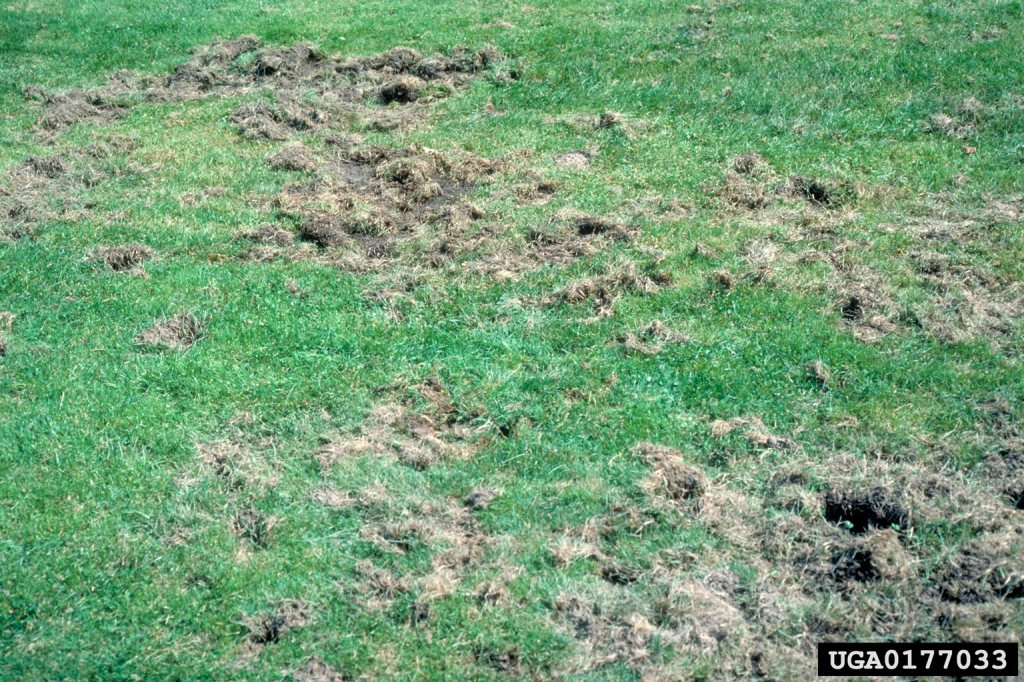
Grubworms may appear in lawns this time of year and begin to feed on roots and organic material in the soil. A few grubs generally should not cause concern, however, more than ten grubs per square foot can cause significant damage. Brown patches can appear in turf as a result of grub feeding. Often in heavy infestations, the grass may feel spongy and can be pulled up easily. Indirect damage can be caused by racoons, skunks, birds or other animals that dig in the soil to eat the grubs. Animals foraging in grass is often the most noticeable sign of a grub infestation.
Life cycle
The major species of white grubs in Kansas are the Japanese beetle, southern masked chafer, and the May beetle (also known as June bug). The Japanese beetle and masked chafer complete their life cycles in one year. Adult beetles emerge in early to mid-summer and begin to lay eggs in the soil. By the end of July, the eggs will hatch and the larvae will begin to feed in the root zone. Annual grubs can cause more damage than other types of grubs with longer life cycles. May/June beetles have a three year life cycle and are most destructive during their second year.
Prevention and control
Early July is the best time to prevent grubs in your lawn if there is a history of infestation. Products containing imidacloprid can be used for prevention. If grub damage has already appeared (later in summer)products with trichlorfon or Dylox can be applied as a rescue treatment. These are contact insecticides that provide control as soon as the grubs come into contact with the product. A few days before applying an insecticide, irrigate the lawn to encourage the grubs to move up to the root zone to increase exposure to the insecticide. After application, irrigate with 1/2 to 3/4 inches of water to move the insecticide to the root zone where the grubs are feeding.
Grubs can also be prevented by maintaining a dense, healthy lawn. Grass should be irrigated deeply and infrequently to develop a well-established root system.
Check out our K-State Research and Extension publication on white grubs for more details.

 Central Kansas Lawn & Garden Blog