
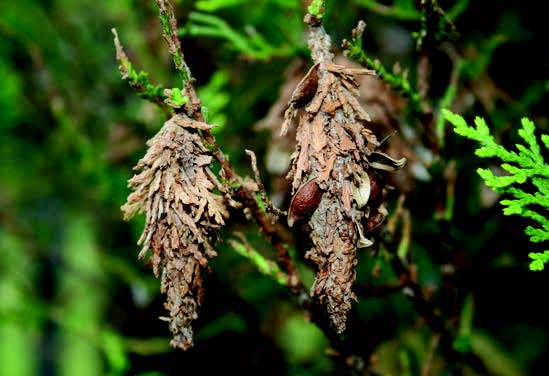

Bagworms outbreaks have been common here in Central Kansas in recent years and so now (the month of June) is a good time to be on the look out for young bagworms that have recently hatched.
Hatching period
Young bagworms hatch from mid-May through mid-June and are initially about 1/8 to 1/4 of an inch long. The larvae spin silken bags around themselves while adding leaf fragments as they feed. Bagworms will feed on a wide variety of trees and shrubs but especially junipers and arborvitae. When the larvae reach maturity, bags can be one to two inches long. Bagworms often go unnoticed until this stage, which is too late for insecticides to be effective. A well-timed and thorough insecticide application is important for management if bagworms need to be controlled.
Management
For small infestations, the bags can be manually removed once the larvae are large enough to easily see. These bags need to be disposed of properly to prevent them from finding a new host. Bags should be placed in a bucket of soapy water rather than a trash bag because larvae can chew through it.
Insecticides can be used to control bagworms in late-June, after all of the larvae have hatched and are actively feeding. Products containing Bacillus thuringiensis subsp. kurstaki or Spinosad work well while larvae are small.
Many other insecticides will also be effective as long as they are labeled for bagworms. It is important to apply insecticides while the larvae are young because once the bags mature, feeding slows down, which reduces their exposure to the insecticide. By early to mid-August, the bagworms will seal themselves into the bags and stop feeding completely. This make insecticides ineffective and a waste of time and money.
Get all the details on bagworms by reading through our publication on bagworms below.

 Central Kansas Lawn & Garden Blog