
Many of us had a first experience of starting seeds at home when we were young. It may have been just a flower or vegetable seed in a cup on the windowsill at home. The result was often a long and leggy plant that just didn’t look quite right.
But, it is possible to start quality transplants at home yourself with just a little knowledge and investment. The trick is that a short, stocky, and healthy transplant requires more light than even the brightest window can provide during the winter. Once you know this trick, you’ll be able to start a wide range of plants with just a little care.

Choose the right light
Growing transplants requires bright light which is not typically available in the home. The secret is to provide plenty of artificial light. There continue to be advances in lighting technology and an ever increasing amount of ‘grow light’ products that can be purchased. The two main categories are fluorescent lights and LEDs.
Fluorescent lights
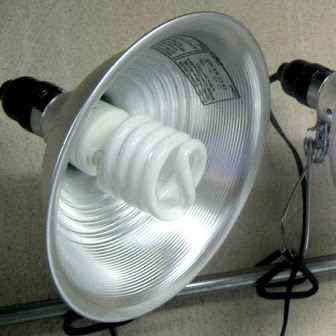
These are tried and true and there are two common types for seed starting at home. Compact fluorescent lamps (CFLs) and tube type fluorescent bulbs. If you have a very small space to start seeds in, the CFLs might be a good option as they can fit into a standard light socket.
For gardeners with enough space, the tube type fluorescent bulbs are a better option since the shape and surface area of the bulb creates more lighting area and these fit well into a shelving system.

The T5, T8 and T12 bulbs are the most common tube types. Bulbs are classified by T for tube and the number represents their diameter 5 = 5/8”, 8 = 8/8 or 1”, and 12 = 12/8” or 1.5”. T8s and T12s fit most standard shop light fixtures. High output T5s (HOT5) are considered the most efficient and best in terms of light quality for fluorescent plant production but they will require a special fixture that is less often found at the hardware store.
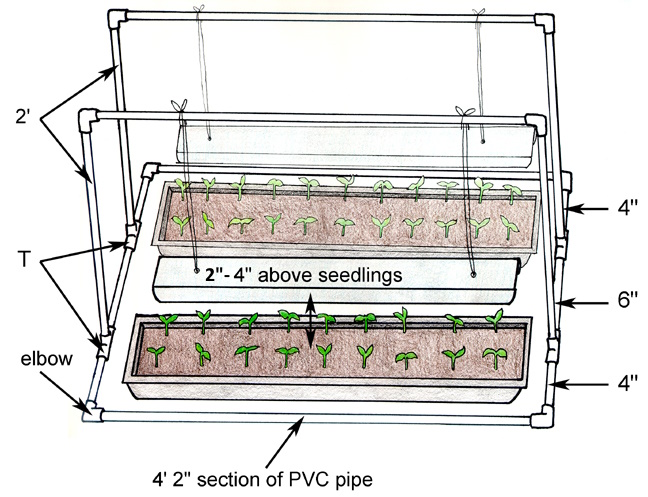
Whether you’re using tubes or CFLs, fluorescent lighting should be kept close to growing plants (within 1-2” of plant tops) and the area they can effectively cover is limited to the surface area of the bulb.
LED lights
LEDs are unique in that they produce a high-quality light with lower energy requirements. Some models produce more than twice the amount of light per watt compared to fluorescent bulbs. The lifespan of LEDs is also notable with some types lasting 2 to 4 times longer than the average fluorescent. Some LED grow light systems are designed to improve efficiency by delivering red and blue spectrums of light only (the wavelengths required for plant growth). This is why some plant growing LEDs give off a red/purple glow.
LED fixtures with a pink/purple light may not be aesthetically pleasing for use in a typical home setting. But, most LED fixtures can be adjusted to give off warm or cool white visible light, which is more typical for home lighting. This will still provide the necessary light spectrum for plant growth.
An Amazon search of “LED grow lights” will provide many LED light options for home gardeners, including light strips, floor or desk lamps, bulbs and hanging lamp fixtures. LED light bulbs can be inserted into many traditional light fixtures or lamps.
Note: If you have fluorescent light fixtures you can also convert to LED tube lights that will fit in your ballast and require less energy.

Light Duration
There are two keys to using lights. The first is duration of light. In order for the developing seedlings to get enough light the fixture must be shining at least sixteen hours a day. Better yet, leave them on twenty four hours. Normal sunlight does not shine that long, but sunlight is far brighter than the shop lights. Compensate for this lower light level by lighting up the plants for a longer period of time. Some LEDs are more susceptible to degrade when running for more than 18 hr. during the day—follow instructions provided with your light.
Keep it close
The second key to success is brightness. As the light moves away from the source the number of foot candles decreases. Short, stocky transplants are produced under the highest intensity of light. Plants get long and leggy on the windowsill because they are stretching for light.
Fluorescent lights should be no further away than two to four inches from the top of the growing plants. Keeping the lamps this close increases the amount of light produced which keeps the plants compact. The supports for the light fixture need to be mounted in such a way that the lights can be lowered at first but then raised as the plants grow. An adjustable chain or some other system works fine.
Some LEDs can be held at higher distances from the plant tops, refer to recommendations that come with the lights.
Blue spectrum
With both LEDs and fluorescent be sure your lights include the cooler blue spectrum, these will often be marked as full spectrum lights or you can look for lights marked as 5000-6500K (Kelvin). This blue spectrum will especially aid in keeping plants shorter and stockier until they are ready for hardening and transplanting. Research has shown that a greater percentage of blue light increases the compactness of seedlings. Generally, blue light is known to suppress plant extension growth and plants grown with blue light are usually shorter with smaller, thicker and darker green leaves compared to plants grown without blue light .
 Central Kansas Lawn & Garden Blog